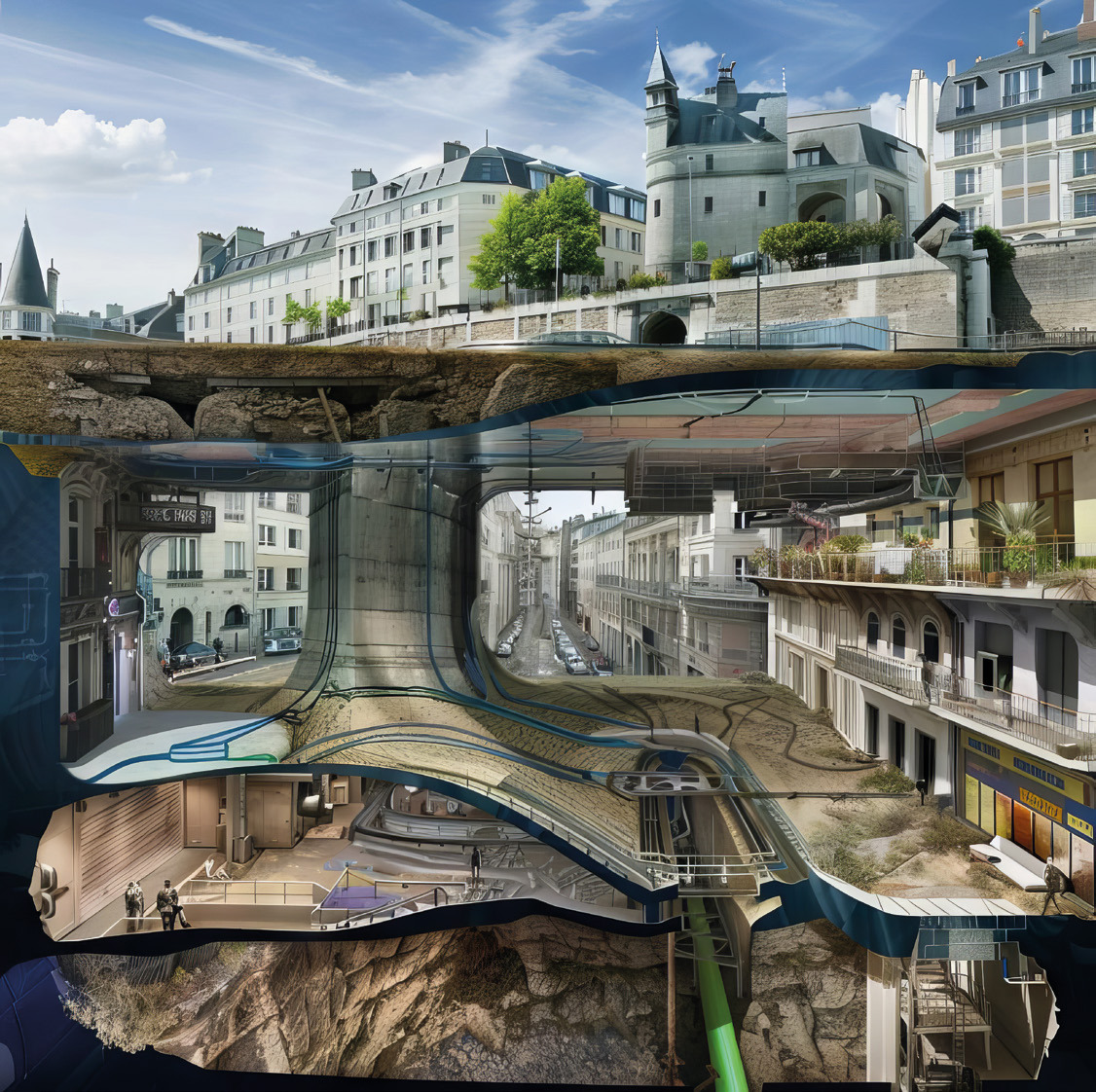
Soutenance de thèse : Arpi Mangasaryan « Generative digital tools applied to architecture: workflows put to the test by the emergence of Artificial Intelligence »
Actualité publiée le 7 octobre 2026
Arpi Mangasaryan, doctorante au CRENAU, soutiendra sa thèse de doctorat intitulée : Generative digital tools applied to architecture: workflows put to the test by the emergence of Artificial Intelligence à l’école nationale supérieure d’architecture de Nantes, Amphi 150, le mercredi 14 octobre 2026 à 14h.
Ecole Doctorale : Sciences de l’ingénierie et des systèmes (SIS). Spécialité : architecture et études urbaines
Composition du jury :
- Bernd DAHLGRÜN, Professeur HDR de construction architecturale / Professor für Baukonstruktion, HafenCity Universität Hamburg – HCU – rapporteur
- Andrea URLBERGER, Professeur HDR des ENSA, Toulouse. Chercheure permanent au LRA. Docteure en Esthétique sciences et technologies des images – rapportrice
- Anetta KĘPCZYŃSKA-WALCZAK Professeure HDR/Full Professor, Ph.D., D.Sc. with Habilitation, Lodz University of Technology, Institute of Architecture and Urban Planning, Politechnika Łódzka – examinatrice
- Lernik MIRZAKHANYAN, Docteur/PhD; Co-fondateur, Directeur produit de la plateforme Beegraphy, Yerevan, Arménie/Co-founder and CPO, BeeGraphy, Yerevan, Armenia – examinateur
- Myriam SERVIÈRES, Professeure des Universités, HDR, École Centrale Nantes, Directrice du CRENAU, UMR CNRS 1563 – examinatrice
- Laurent LESCOP Professeur HDR des ENSA, Nantes, AAU-CRENAU, UMR CNRS 1563 – directeur de thèse
Membre(s) invité(s) :
- Anne PHILIPPE, Maîtresse de conférence des ENSA, Nantes, AAU-CRENAU
- Xavier POIRIER, Architecte DE, Directeur fondateur/ founder director, studio d’infographie 3D Spectrum Immersive Architecture, Saint-Nazaire
Résumé :
Architectural design develops through successive translations between drawings, models, images, simulations, datasets, and specialist knowledge. As these elements multiply, the design process becomes increasingly fragmented. This thesis investigates how Artificial Intelligence can help architects navigate this fragmentation while maintaining control over the project’s direction. The research proposes a methodology based on project-specific AI modules, each assigned a clearly bounded task. These modules identify, process, and translate information, returning their outputs for architectural validation and reintegration. The architect remains responsible for defining intentions, selecting sources, controlling transformations, and evaluating results.
Four experiments examine human–AI interaction, conceptual exploration, workflow transitions, and territorial analysis. Together, they show how AI can support movement between representations and disciplines while preserving architectural authorship and specialist validation. A professional proof of concept with SNKH Studio further tests the methodology within active architectural visualisation workflows. The thesis contributes a reusable approach to integrating AI through modular, architect-directed operations. It positions AI as a mapping and translation tool that supports the design process while keeping decisions and responsibility with the architect. It also establishes a foundation for future architectural AI connecting visual representations with geometry, materials, structure, environmental performance, and physical behaviour.
Soutenance accessible en visioconférence : https://meet.google.com/mmg-vmyc-twk
Catégorie : AAU, CRENAU
Tags : Conception architecturale, Intelligence artificielle, processus de conception